Losing a single tooth can feel like a small emergency, especially when it happens without warning.
The good news is that you have real choices, and most of them stay open longer than people expect.
What shrinks over time is the simplest version of those choices.
Getting an implant consultation within a few weeks of tooth loss protects your options, even if the implant itself is placed months later.
Knowing when to get a dental implant after tooth loss starts with evaluating the socket, surrounding bone, and gum tissue.
Early planning can help your dentist determine whether immediate, early, or delayed implant placement is appropriate.
That said, “sooner” and “immediately” are not the same thing. Placing an implant the same day a tooth comes out works beautifully in some mouths and creates problems in others.
The reason your tooth was lost, the health of the surrounding gums, and how much bone is left all shape what belongs on your calendar.
Key Takeaways
- An early evaluation preserves the widest range of implant timing choices, even when placement is later.
- Bone around a lost tooth narrows fastest in the first year, which is why planning early simplifies treatment.
- Years-old gaps are still treatable, though grafting or a sinus lift may be added to rebuild support.
Table of Content
- Why an Early Implant Consultation Protects Your Options
- What Happens to the Jawbone After One Tooth Is Lost
- What Determines Whether You Are Ready for a Single Implant
- What If You Have Already Been Missing a Tooth for Years?
- A Prompt Evaluation Keeps More Paths Open
- Frequently Asked Questions
Why an Early Implant Consultation Protects Your Options
Booking an evaluation early gives your dentist information that disappears once the socket heals over and the ridge starts to flatten.
Imaging taken soon after tooth loss shows the exact bone width, bone height, and root position your dentist needs to decide between placing an implant right away, waiting a couple of months, or building up support first.
At Esthetic Dentistry Pittsburgh, that first visit is about mapping your situation, not committing you to surgery on the spot. A conversation about single dental implants early on tends to reduce surprises later.
Can a Single Implant Be Placed Immediately After Tooth Extraction?
Sometimes, yes. Immediate placement means the implant goes into the socket during the same appointment as the tooth extraction, and it works best when the tooth was lost to a fracture or deep decay with no active infection and the surrounding bone walls are intact.
A few conditions push against same-day placement:
- Active infection or an abscess at the root tip
- Thin or broken bone on the cheek side of the socket
- Gum inflammation that needs treatment first
- A socket much wider than the planned implant
Your dentist checks these with a 3D scan and a direct look at the site once the tooth is out. Even with a same-day placement, the final crown often waits until healing is complete.
When Is Early Implant Placement a Better Choice?
Early placement means waiting roughly 8 to 12 weeks after the tooth comes out, and it is the middle path many patients land on.
A common recommendation is that implants go in 8-12 weeks after losing a tooth, which gives gum tissue time to close and seal the site while most of the original bone is still there.
This window suits you well if the tooth was removed because of infection, if the gum tissue looked thin or receded, or if your dentist wants soft tissue to mature before shaping the area for a front-tooth crown.
You get a cleaner, healthier foundation without waiting long enough for the ridge to shrink.
Why Delayed Treatment Can Require More Preparation
Delayed placement means six months or more after tooth loss, and it usually adds a step.
Bone that no longer holds a root stops getting the daily pressure that keeps it dense, so the ridge narrows and the useful volume drops.
Delayed implant treatment may still be possible, but bone changes can sometimes make grafting or additional treatment necessary before implant placement.
Knowing that in advance helps you plan both your time and your budget, and reviewing dental implants financing options early takes some pressure off the decision.

What Happens to the Jawbone After One Tooth Is Lost
The jawbone under a missing tooth begins shrinking within weeks because tooth roots stimulate bone every time you chew, and that signal stops when the root is gone.
Neighboring teeth also start responding to the open space, which changes how your bite meets and, over years, can soften the contours of your lower face.
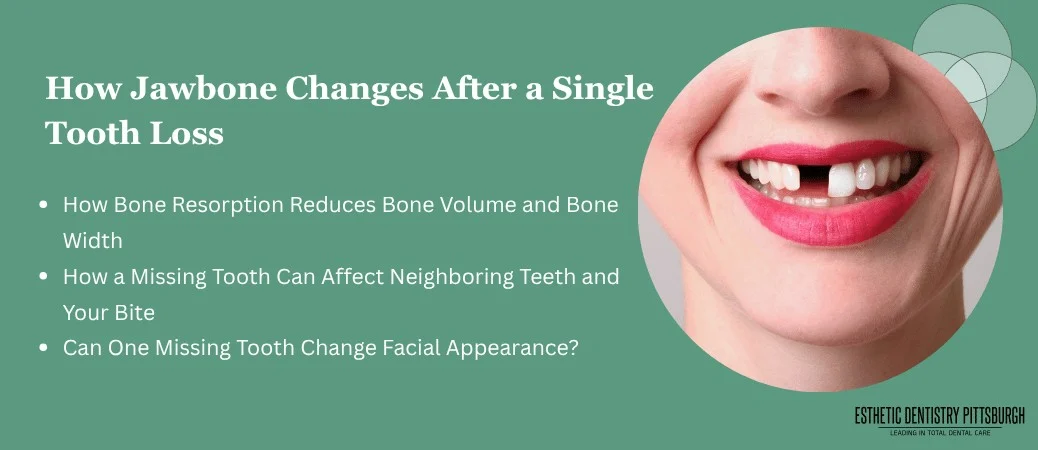
How Bone Resorption Reduces Bone Volume and Bone Width
Bone resorption is your body reabsorbing bone it no longer sees a use for. The change is fastest early: you can lose the bone width in that spot during the first year, and 40 to 60% of the original bone height after a decade.
Width matters more than most people realize. An implant needs enough bone on both sides to be fully surrounded, so a ridge that has narrowed to a thin blade may need widening even when the height looks fine on an X-ray.
How a Missing Tooth Can Affect Neighboring Teeth and Your Bite
Teeth lean toward open space. The teeth beside the gap drift and tilt, and the tooth in the opposite jaw can drop or rise into the empty area, a movement called super-eruption.
Once that shifting starts, the gap changes shape. Restoring the space may then involve orthodontic movement or reshaping before a crown can fit correctly.
Tilted teeth also create tight spots that trap plaque, which raises the risk of decay and gum problems on otherwise healthy teeth.
Can One Missing Tooth Change Facial Appearance?
One missing tooth rarely changes your face in a way others would notice, especially a back tooth.
The visible effects show up with front teeth, where a shrinking ridge can flatten the tissue under your lip, or after several years of untreated loss in the same area.
Larger changes like facial sagging follow multiple missing teeth. Jaw discomfort is more common than cosmetic change with a single gap, since chewing shifts to one side and loads the joint unevenly.
What Determines Whether You Are Ready for a Single Implant
Implant readiness comes down to healthy gums, enough bone to hold the implant, and a body that heals well.
Those three pieces get checked at your evaluation, and any one of them can move your timeline without ruling out treatment.
Why Gum Health and Oral Hygiene Matter Before Surgery

Gums have to be free of active infection before an implant goes in. Gum disease is a bacterial infection that destroys the bone holding your teeth, and placing an implant into that environment invites the same breakdown around the new post.
If your dentist finds bleeding, deep pockets, or tartar under the gumline, treating that comes first.
Steady brushing and flossing habits also matter after placement, because implants can develop a gum infection of their own.
Learning the signs of dental implant failure helps you catch trouble early.
How Overall Health and Healing Affect Implant Candidacy
Your general health shapes how well bone grows around an implant. Uncontrolled diabetes, smoking, some medications for bone density, and recent radiation to the jaw all slow healing enough to affect planning.
None of these are automatic disqualifiers. Implant candidacy comes down to medical necessity, adequate bone support, and overall health for surgery, which your dentist reviews alongside your medical history.
Quitting smoking even a few weeks before surgery measurably improves your odds.
What Osseointegration Means for Long-Term Stability
Osseointegration is bone growing directly onto the implant surface, locking it in place. This is what makes an implant feel like a real tooth root, and it takes about two and a half months at minimum before the final crown is attached.
That fusion is why success rates hold up: single-tooth implants show a survival rate above 95% over 10 years in well-selected patients who keep up with cleanings.
What If You Have Already Been Missing a Tooth for Years?
A gap that is five, ten, or twenty years old is still very treatable. Modern implant dentistry routinely treats patients missing teeth for many years, with the extra work focused on rebuilding the bone support that faded while the space sat empty.
When Bone Grafting Can Rebuild Implant Support
Bone grafting adds material to a thin or short ridge so an implant has something solid to hold onto.
The graft can be your own bone, processed donor bone, or a synthetic mineral, and your body gradually replaces it with a new bone of its own.
Small grafts placed at the same time as the implant add little to your schedule. Larger rebuilds are done first and need four to nine months to mature before placement.
Your 3D scan tells your dentist which category you fall into.
When a Sinus Lift May Be Needed for an Upper Back Tooth
Upper molars and premolars sit right below the sinus cavity, and the floor of that sinus drops lower as bone in the area is lost.
A sinus lift gently raises the sinus membrane and packs bone graft material underneath, creating the height an implant needs.
This is a well-established procedure with a straightforward recovery. Expect some congestion and instructions to avoid nose-blowing for a couple of weeks.
How Other Tooth Replacement Options Compare
A single implant, a bridge, and a partial denture each fill the gap differently.
| Single implant | Implant-supported or traditional bridge | Partial denture | |
| Affects neighboring teeth | No | Traditional version requires crowning them | Clasps rest on them |
| Slows jawbone loss at the site | Yes | Only implant-supported version | No |
| Removable | No | No | Yes |
| Typical lifespan | 15+ years | 10 to 15 years | 5 to 8 years |
| Time to complete | 3 to 9 months | A few weeks | A few weeks |
A bridge makes sense when the teeth on either side already need crowns. Partial dentures may provide a removable tooth replacement option when implant surgery is not appropriate or when a patient prefers a nonsurgical approach.
A Prompt Evaluation Keeps More Paths Open

An early dental evaluation is the one step that costs you almost nothing and preserves nearly every option you have.
It tells you whether your site suits immediate placement, whether waiting eight to twelve weeks gives you a better foundation, or whether grafting belongs in the plan.
You are not on a deadline. Bone changes fastest in the first year, so a visit in the first month or two after tooth loss simply means fewer added steps and a shorter path to a finished crown.
Bring your questions to that appointment, including what you would do differently if you waited a year.
The team at Esthetic Dentistry Pittsburgh can walk you through imaging results and lay out a schedule built around your bone, your gums, and your life.
Whether you end up with dental implants or another form of tooth replacement, knowing your actual starting point makes the choice a lot easier to sit with.
Frequently Asked Questions
Is a single tooth implant worth it?
For most people with healthy gums and adequate bone, yes.
A single implant replaces the root as well as the crown, so it slows bone loss at that spot and leaves the neighboring teeth untouched, and single-tooth implants survive past 10 years in more than 95% of well-selected cases.
What is the typical timeline for getting a single tooth implant?
Plan on three to nine months from start to finished crown. Osseointegration alone takes about two and a half months, and any bone grafting adds four to nine months before the implant can be placed, which is why your dentist gives you a personal schedule after imaging.
Can I get an implant immediately after a tooth extraction?
Sometimes, when the socket walls are intact and there is no active infection. Your dentist confirms this with a 3D scan and a look at the site once the tooth is out; a wide socket, thin bone, or inflamed gums usually shifts placement to a later visit.
Will I need a bone graft if I wait to replace one tooth?
Possibly, since bone width in the area can drop by roughly a quarter within the first year.
Waiting a few months rarely requires grafting, while waiting several years often does, and a scan is the only way to know which applies to you.
At what age should you not get a tooth implant?
There is no upper age limit for implants. Adults in their 80s and 90s receive them routinely when their health and bone support allow, though implants are held off for teenagers and young adults until jaw growth finishes, since a placed implant will not move with a still-developing jaw.